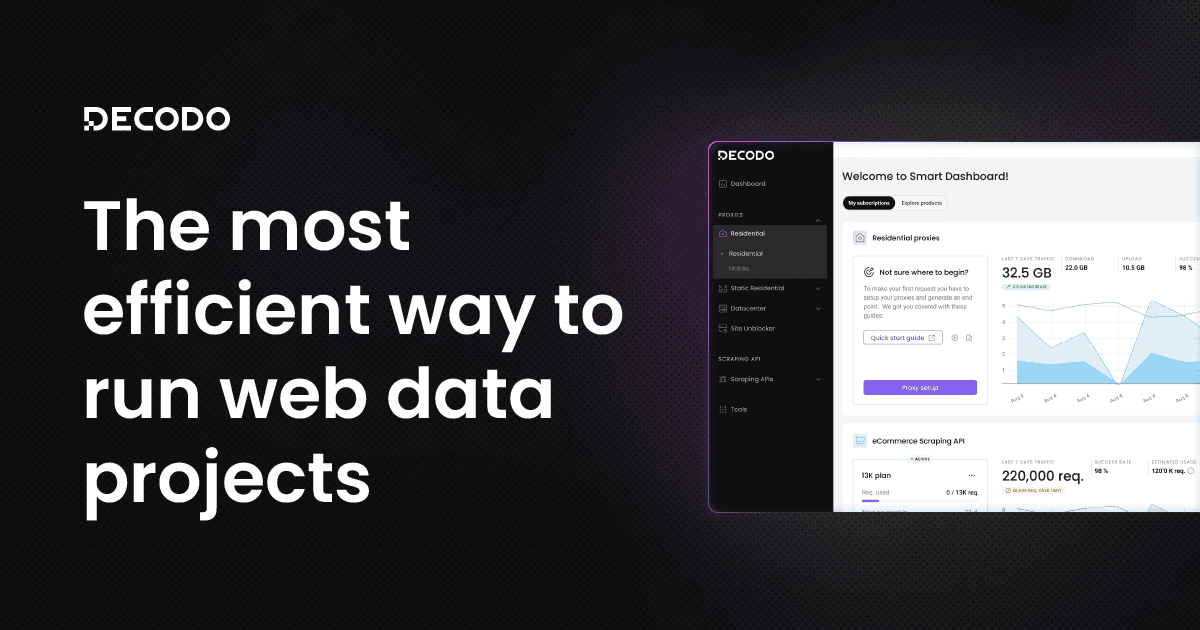

Decodo is one of the better-known self-serve proxy platforms in the market, but the real question is not whether the brand is visible. The real question is whether the service is actually worth paying for in 2026 if you need stable residential traffic, long sticky sessions, clean geo-targeting, and a dashboard that does not slow your team down.
This review is written from that practical angle. Instead of repeating generic claims about “premium proxies,” I am focusing on what matters to buyers: what Decodo is good at, where it is merely average, what its current product lineup looks like, how pricing should really be interpreted, and which kinds of users should buy it versus shortlist something else.
Quick Verdict
Decodo is a strong option for buyers who want one proxy vendor that covers the full working set: residential, mobile, ISP, and datacenter proxies, plus scraping-related tooling. It is especially good for self-serve teams that need solid network quality without immediately moving into a heavier enterprise procurement process.
Its main strengths are straightforward:
- Residential and ISP use cases are where it feels most polished.
- Sticky session control is good enough for many browser and multi-step flows.
- Geo-targeting depth is strong for regional QA and localized data work.
- The dashboard and onboarding flow are easier than many teams expect from a multi-product proxy vendor.
Its limitations are also clear:
- Pricing can look better or worse depending on whether you compare monthly entry rates, pay-as-you-go plans, or special campaign pages.
- It is not the absolute cheapest option in every lane.
- If your needs are extremely enterprise-specific, there are vendors with deeper top-end infrastructure.
What Decodo Actually Is in 2026
Decodo is the current public brand for a service many readers will remember under an older brand identity. That continuity matters because a lot of older reviews, screenshots, and forum posts still use the legacy naming. Functionally, though, you should evaluate the current Decodo product pages and current pricing pages, not recycled 2022 or 2023 listicles.
As of June 1, 2026, the official Decodo product surface is broad enough to cover most common proxy buying paths:
- Residential proxies for location-sensitive web data collection and regional access simulation.
- Mobile proxies for mobile ASN identity and tougher target environments.
- Datacenter proxies for cheaper high-throughput traffic.
- ISP proxies for longer-lived sessions and cleaner identity persistence.
- Scraping-related services for teams that want more than raw proxy access.
That breadth is important because many buyers do not want a different vendor for each workflow. Decodo’s real appeal is that one account can cover multiple traffic strategies without making the user jump into an overly complex control plane.
At a Glance
| Category | Decodo Snapshot |
|---|---|
| Best fit | Self-serve teams needing a full proxy stack with strong residential and ISP options |
| Core products | Residential, mobile, datacenter, ISP, scraping services |
| Protocols | HTTP(S), SOCKS5 |
| Auth methods | Username/password and IP whitelisting |
| Targeting depth | Country, city, U.S. state, ZIP, ASN depending on SKU |
| Session behavior | Rotating plus sticky sessions, with longer persistence options on relevant products |
| Support | 24/7 live support and email |
| Main buying caution | Read the exact product page you plan to buy because pricing varies by SKU family |
Residential Proxies: Decodo’s Strongest Lane
If you are looking at Decodo seriously, residential proxies are probably why. The official residential product material currently highlights a very large IP pool, broad location coverage, sticky session support, and strong success-rate messaging. More importantly, residential is the product family where Decodo feels best aligned with how most proxy buyers actually work: SERP data collection, localized page checks, ecommerce intelligence, ad verification, and browser-led data gathering that would be harder to sustain on cheaper datacenter-only traffic.
This is also where Decodo’s positioning makes the most sense. It is not the most exotic enterprise data platform in the market, but it does a good job combining ease of setup with enough control to support real operations. For many teams, that balance matters more than chasing the single largest marketing number on a comparison chart.
Another point in Decodo’s favor is the quality of its self-serve experience. Buyers who do not want to spend two weeks in back-and-forth sales conversations can usually get into testing quickly. That matters because proxy evaluation is always partly empirical. The faster you can start a controlled pilot, the faster you can find out whether your own targets agree with the marketing copy.
Mobile Proxies: Useful, But Only If You Actually Need Mobile Identity
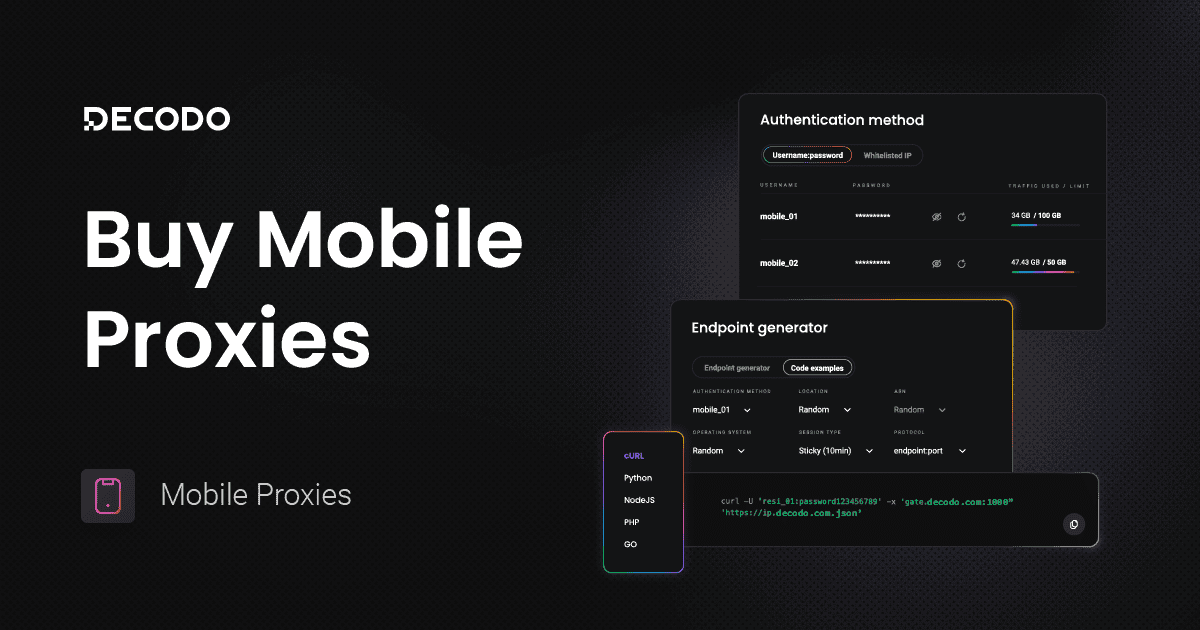
Decodo’s mobile proxy line is not there just to fill a catalog slot. Official Decodo material positions mobile as a large dedicated network with broad carrier coverage and strong geographic spread. That makes it relevant when your target environment behaves differently for mobile traffic, or when your workflow specifically benefits from mobile ASN identity.
That said, mobile proxies are frequently over-bought by people who do not need them. If your main goal is ordinary public web data collection with solid acceptance and decent geographic accuracy, residential usually gets you most of the way there without the same cost profile. Mobile should be chosen because your target or traffic pattern clearly benefits from it, not because “mobile” sounds automatically better.
In other words, Decodo’s mobile proxies look strong on paper, but they are best treated as a specialized tool. Buyers who understand when mobile identity matters will likely value the product. Buyers who simply want “the strongest thing available” may end up paying for capacity they do not really need.
Datacenter Proxies: The Throughput Play
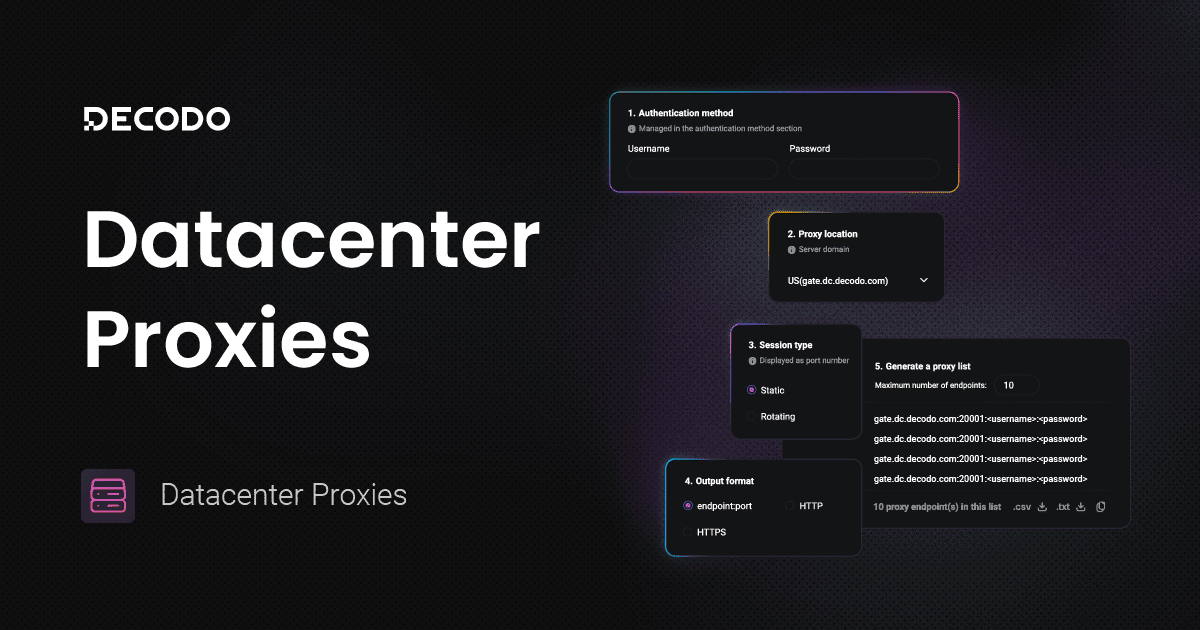
Datacenter is where Decodo becomes a cost and throughput decision rather than a stealth decision. The official datacenter line covers both rotating and dedicated-style paths, and this is the product family to consider when you care more about volume, speed, and economics than about residential identity.
For API-driven collection, lower-friction targets, or tasks where you already have a mature retry and failure-handling layer, datacenter can make a lot of sense. It is also the product you are most likely to benchmark directly against price-focused competitors. If your internal measurement framework is good, you can quantify whether Decodo’s datacenter offering is worth the premium over more bare-bones alternatives.
My view here is simple: Decodo’s datacenter product is useful, but it is not the main reason most buyers should choose the platform. If your business is overwhelmingly datacenter-centric and price compression is the core objective, you should compare it carefully against specialists. If your workloads are mixed, though, Decodo’s datacenter line becomes more attractive because it sits inside a broader, better-balanced product portfolio.
ISP Proxies: Quietly One of the Best Reasons to Consider Decodo
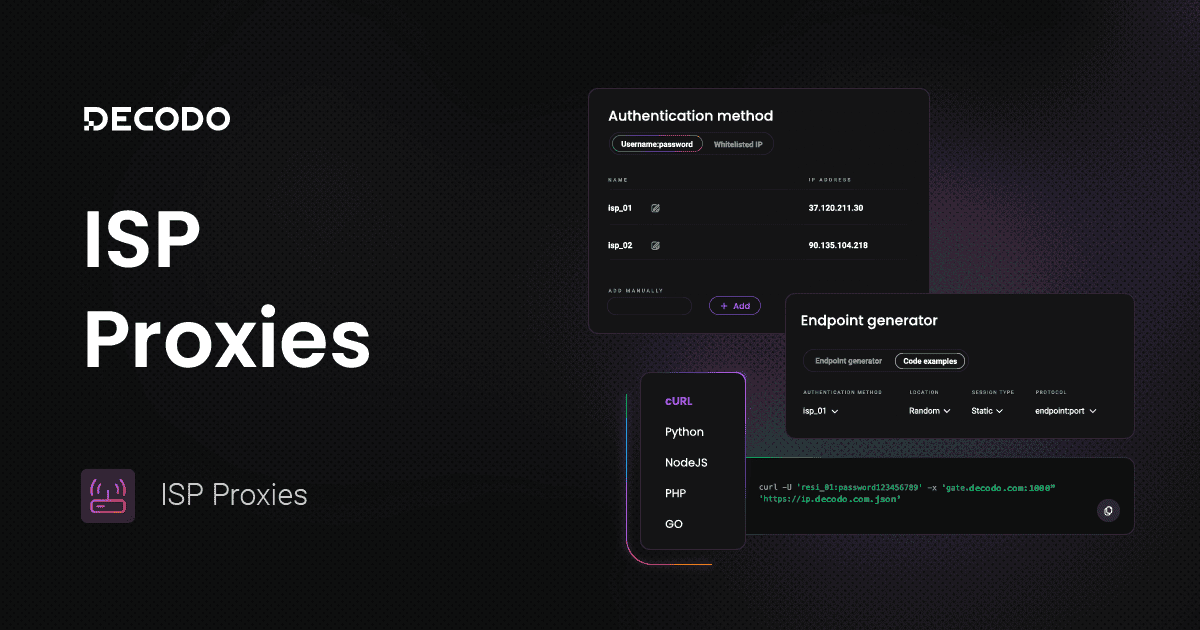
ISP proxies are where Decodo often makes more sense than people expect. For users who need longer-lived sessions, less churn, and a cleaner identity profile than typical datacenter traffic, ISP can be the sweet spot. You get more persistence than standard rotating residential, but you do not necessarily need to jump straight to the highest-cost option for every task.
This is particularly relevant for multi-step browsing flows, repeated access to the same target environment, and QA or operational tasks where session continuity matters. Decodo’s internal merchant baseline already treats the platform as especially strong in self-serve residential and ISP-led buying contexts, and that matches what the public product mix suggests.
For many buyers, ISP is the product they should test right after residential, not last. A lot of teams either overuse residential for everything or jump from datacenter straight to mobile. Decodo’s ISP line is a good reminder that session stability is often the real problem to solve.
Pricing: Read the Right Page, Or You Will Misjudge the Value
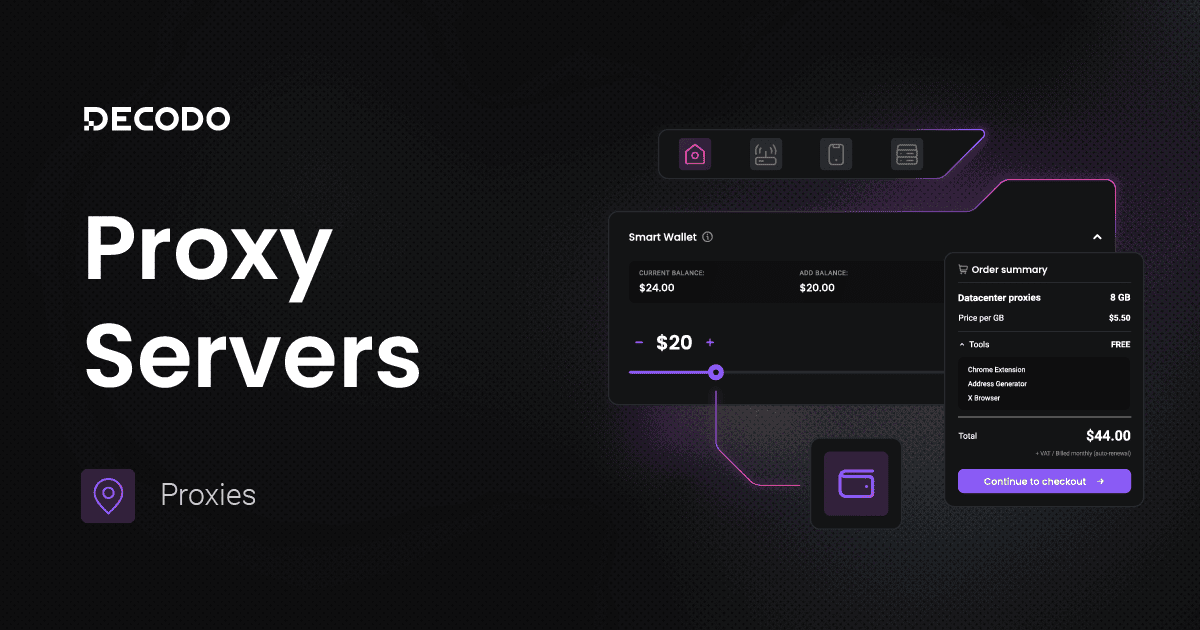
Pricing is the area where the average proxy review becomes unreliable. Old articles tend to quote one number forever, but Decodo’s current product stack does not work that way. Different SKUs have different entry models, some pages emphasize monthly entry points, some campaign pages highlight short-term offers, and pay-as-you-go logic can differ from subscription logic.
The current structured merchant bundle in `proxy-merchant-intel`, last reviewed on 2026-05-25, points to entry pricing around:
- Residential: about $2.2/GB on the official pricing baseline
- Mobile: about $3/GB on the official pricing baseline
- ISP: about $1.3/GB on the official pricing baseline
- Datacenter: about $0.39/GB on the official pricing baseline
Those baseline figures should not be read as universal checkout truth for every plan. The right interpretation is this: Decodo is competitive when you evaluate the actual product page you intend to buy, but sloppy comparison work will distort the result. If one vendor’s monthly entry tier is compared to another vendor’s pay-as-you-go tier, the article is doing a bad job.
That is why I would judge Decodo on effective cost per successful outcome, not just the headline starting price. A vendor that costs slightly more on paper can still be cheaper if it saves retries, operational debugging, and failed-session waste. Decodo has enough product quality that this distinction matters.
Operational Quality: Where Decodo Feels Mature
Decodo scores well on the day-to-day basics that teams notice quickly: onboarding is fast, the control surface is not confusing, authentication methods are standard, protocols are normal, and geo-targeting options are strong enough for serious regional work. The official pages also continue to emphasize long sticky-session options, which matter for multi-step browser flows and repeated access patterns.
The most useful way to think about Decodo operationally is that it removes friction. That does not mean it eliminates the need for good internal request discipline. It means your team spends less time fighting avoidable setup and routing problems, and more time measuring actual workload behavior.
That difference is easy to underestimate until you compare providers side by side. Cheap proxy access with poor consistency often creates invisible labor cost. Decodo is one of the providers where the service can justify itself through reduced operational drag, not only through raw proxy performance.
Where Decodo Is Strong, And Where It Is Not
Where It Is Strong
- Residential-heavy teams that want a reliable self-serve platform.
- Buyers who want residential, ISP, datacenter, and mobile options under one roof.
- Geo-sensitive work where city, state, or ZIP targeting matters.
- Teams that value cleaner onboarding and predictable dashboard operations.
Where It Is Less Compelling
- Price-first datacenter-only buyers comparing nothing but the lowest unit cost.
- Teams that need the deepest enterprise data-stack integration available anywhere in the market.
- Users who do not read the exact pricing page they are buying from and then blame the provider for comparison errors.
Decodo vs Other Shortlist Candidates
| Brand | How It Compares | Best Fit |
|---|---|---|
| Decodo | Best balance of self-serve usability and multi-product coverage | Mixed workloads, residential-first teams, practical buyers |
| Bright Data | Heavier enterprise ceiling and broader top-end infrastructure | Large organizations with more advanced data demands |
| SOAX | Often appreciated for clean controls and quality-focused positioning | Teams that care strongly about targeting and control quality |
| Oxylabs | Strong enterprise reputation and broader data infrastructure positioning | Higher-budget data-heavy teams |
| Proxy‑Seller | More attractive when the conversation is very datacenter and cost driven | Users who optimize harder for unit price in specific lanes |
That comparison is the right level of nuance. Decodo should not be sold as “best at everything.” It should be sold as one of the more convincing overall packages for buyers who want good network quality, solid product breadth, and less friction in the first month of use.
Who Should Buy Decodo
You should seriously consider Decodo if your workload is residential-heavy, your team needs more than one proxy type, and you prefer a service that is easy to test without an enterprise sales project. It also makes sense for agencies and smaller data teams that want strong capability without having to over-engineer vendor management.
You should be more skeptical if your operation is almost entirely price-sensitive datacenter traffic, or if your procurement criteria are built around the most enterprise-specific features in the market. In those cases, Decodo may still be good, but it stops being the obvious fit.
Final Verdict
Decodo is not just coasting on brand recognition. As of June 1, 2026, it still looks like a high-quality, broadly useful proxy vendor with a particularly strong case for self-serve residential and ISP buyers. Its advantage is not that it wins every category. Its advantage is that it is one of the better all-around buying decisions for teams that need a real proxy stack and want to get into production without unnecessary friction.
If I were shortlisting vendors for a practical, mixed-workload team today, Decodo would stay on the list. The only condition is that I would evaluate it with the correct product page, the correct pricing model, and a 7- to 14-day workload test instead of trusting stale comparison content.
FAQ
Is Decodo still worth considering after the rebrand?
Yes. The rebrand itself is not the issue. The real issue is that older pages still use legacy naming and outdated pricing references, so you need to judge the current Decodo product pages.
Which Decodo product should most buyers test first?
Residential is the default starting point for most buyers. ISP should usually be the second test if session persistence matters. Datacenter and mobile should be chosen for more specific reasons.
Is Decodo cheap?
It can be competitive, but “cheap” depends on which plan you compare and what workload you run. The more useful metric is effective cost per successful result, not a single starting price copied from one page.
Does Decodo support sticky sessions?
Yes. Sticky sessions remain one of the more important reasons to take the platform seriously for browser-led and continuity-heavy tasks.